
The Death of the “Windows Default” and the Rise of Technical Sanity#
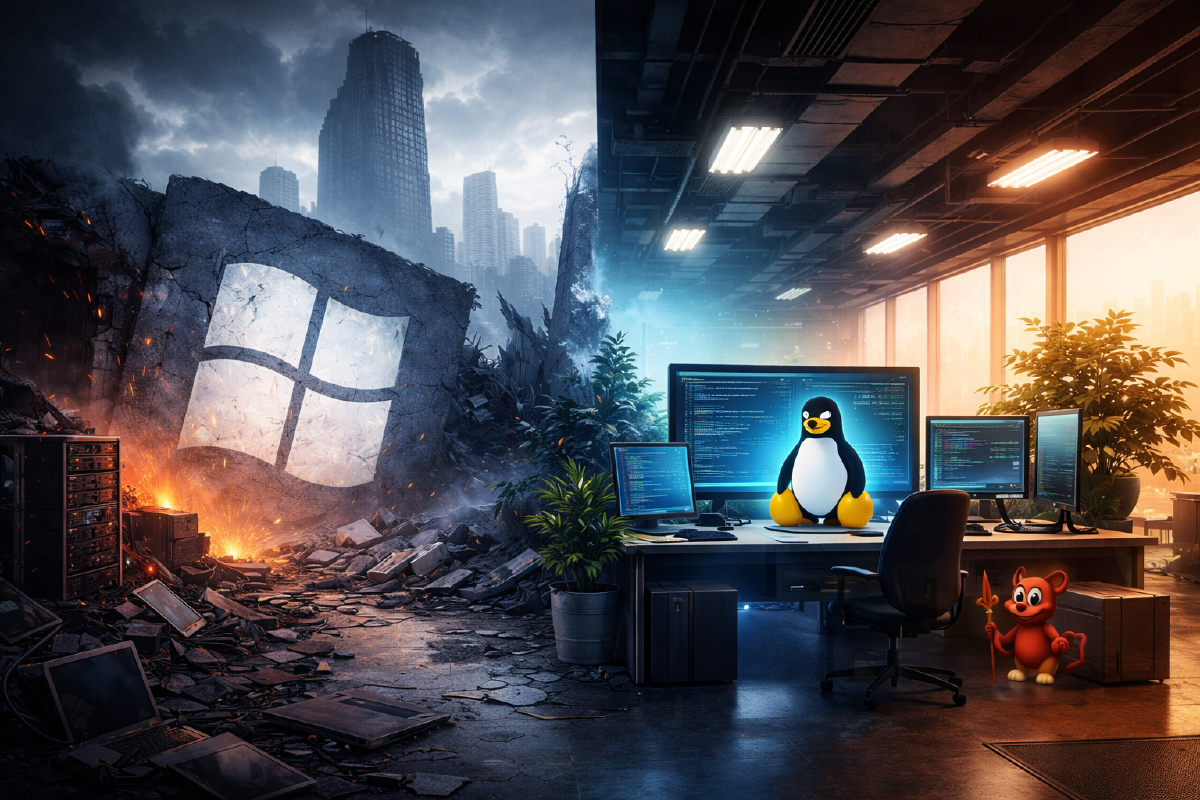
The era of Microsoft as the undisputed king of the enterprise desktop is over. It is not a quiet transition, but a slow and visible collapse driven by forced hardware upgrades such as Windows 11 and TPM 2.0, invasive telemetry, and a security model that has become increasingly fragile.
What used to be considered the safe default has turned into an expensive liability. Many organizations have not admitted this yet, largely because admitting it would require questioning years of architectural decisions.
The End of Blind Trust#
For decades, management chose Microsoft because it felt safe and familiar. It was the industry standard, rarely questioned and almost never challenged.
Today, that trust no longer holds.
- Windows 10 end of life forces costly and wasteful hardware replacements
- Security updates frequently break core functionality
- Licensing costs keep rising while the operating system itself delivers diminishing value
When most employees work almost entirely in a browser, paying for a bloated and fragile operating system is not strategy. It is inertia. It is operational neglect disguised as compliance.
We have seen this pattern repeatedly. Loud reactions, late panic, and policy driven by headlines instead of architecture. I described this behavior in detail in Company Laptops, Personal Use and the Security Balance and later expanded on it in NCSC, BYOD and the Late-Stage Panic Rant.
Organizations wait until the final moment to address structural problems instead of building resilience into their environments from the start.
The Architectural Failure Behind the Windows Default#
This problem is not about one bad Windows release. It is architectural.
Modern Windows has evolved into a policy enforcement endpoint first and a work machine second. Telemetry pipelines, license validation, compliance hooks, and centralized control dominate its design. Security is added through increasing layers of complexity instead of reduction and clarity.
This model assumes always-on connectivity, homogeneous hardware, and passive users rather than technical professionals.
It may work for kiosks and tightly scripted office roles. It fails the moment you give the same system to engineers, security specialists, or operations staff who need to understand, inspect, and control their tools.
What we are witnessing is not the failure of Windows as software. It is the failure of Windows as an engineering platform.
Identity Is the Real Lock-In#
The real lock-in is not Windows itself. It is identity.
Once an organization fully commits to Microsoft Entra ID, the desktop stops being interchangeable and becomes a strategic endpoint. Windows fits naturally. Linux does not, and that is by design.
Entra ID is not a traditional directory service. It is a cloud identity broker optimized for Windows endpoints and browser-based access. There is no native LDAP, no classic Kerberos realm, and no first-class Linux workstation concept.
Linux desktops can authenticate to web services and participate in single sign-on flows. They cannot belong to the identity fabric in the same way Windows machines do.
This asymmetry is not a technical oversight. It is a deliberate architectural choice.
Once identity becomes cloud-only and vendor-specific, the operating system stops being a choice and becomes an outcome.
Linux Desktops Are Not an Anarchy Problem#
A persistent myth in corporate IT is that allowing Linux on the desktop leads to chaos. In practice, the opposite is often true.
Linux enforces clarity. Configuration is explicit. Authentication paths are visible. Logs are readable and coherent. When something breaks, you can trace it without reverse engineering opaque interfaces or waiting for vendor acknowledgement.
I have argued this repeatedly from hands-on experience, most explicitly in Taming the Beast: My Arch Linux Install for a Clean, Mean, and Secure Work Machine.
Actually, if I am being completely honest: give me a FreeBSD laptop and a Beastie plushie. That is where the real sanity lies. But for the rest of the world, Linux is the practical escape hatch.
For technical professionals, this is not about ideology or preference. It is about operability.
What organizations fear is not Linux itself. It is losing the illusion of control that locked-down Windows environments provide.
Illusion is not security.
The Price of Compliance Theater#
From CISO roles to leadership positions at large institutions, I have seen the cost of this model up close.
High workloads and ignored warnings are not abstract technical problems. They are personal health risks. I have experienced seven burnouts myself, largely caused by fighting systems that prioritize vendor lock-in over human and technical resilience.
This handcuffing effect, where professionals are expected to keep fragile systems running while being stripped of agency, is exactly what I described in Hands-On or Handcuffed.
It also ties directly into the broader erosion of trust in modern work environments, something I explored further in Farewell Remote Work, the Future Is Trust (A Deeper Dive).
Compliance becomes the objective.
Security becomes theater.
The damage is absorbed quietly by people.
Linux as a Corporate Desktop Is Inevitable#
The question is no longer whether Linux belongs on the corporate desktop, but how honestly organizations are willing to adopt it.
For non-technical staff, managed Linux desktops make sense. They are predictable, stable, cost-effective, and immune to forced hardware churn.
For technical staff, freedom of choice is not a perk. It is a productivity and sustainability requirement.
A dual strategy is realistic:
- Managed Linux desktops for general staff
- Self-managed but policy-aware Linux systems for engineers and specialists
Windows can still exist where it genuinely adds value. The mistake is treating it as the default everywhere, long after it stopped earning that position.
The Verdict#
Microsoft is no longer the safe choice. It is the expensive and fragile one.
Moving away from the Windows default is no longer a niche experiment. It is a survival strategy for organizations that value resilience, autonomy, and human sustainability.
Stop following the herd.
Stop paying for fragility.
Start securing your environment, and give people tools that let them do their work properly.