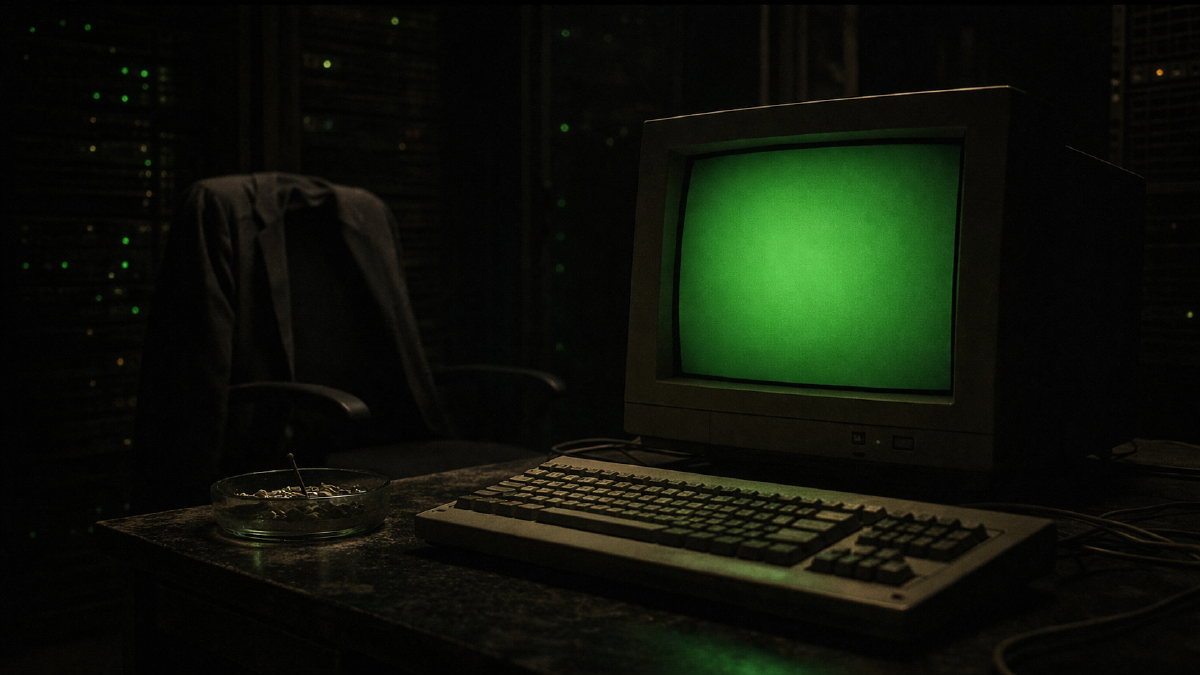

Someone recently told me they’d been in IT for seven years. “That’s a long time,” they said. I didn’t respond. I just thought about the Eekholt.
The smoke-filled engine room#
There was a time when the internet felt like a physical place. You could hear it in the hum of a BSDi server and smell it in the ozone of a CRT monitor. At the Eekholt, as an employee of XS4ALL, work didn’t stop at the door. Neither did the thinking. A pinball machine and an unspoken agreement defined the culture: if you kept the packets flowing, you were king. We weren’t “resources” or “headcount.” We were operators.
You took the train to Diemen Zuid and walked the rest. Nobody called it a commute. It was the price of admission.
A handle on #stropdas or a @hacktic.nl address meant you belonged. It was a meritocracy where your code and your uptime were your only resume. Nobody asked for a degree. They looked to see if you knew what was wrong with the machine.
The romanticism of the raw#
The nostalgia isn’t about the hardware. It’s about the autonomy. For some of us, it started even before that. A 9600 bps modem, an ANSI screen, and Flevonet keeping Lelystad online on PTT goodwill and a provincial guarantee. The Eekholt came later. The obsession started there.
We lived through the “make world” days of FreeBSD, Red Hat before it became RHEL, and the grueling compile times of Gentoo. At Euronet, BSDi servers hummed in the background while WindowMaker kept your desktop out of the way. No nonsense. Just work. We built the digital infrastructure of the Netherlands on gut feeling and technical insight, while the rest of the world was still figuring out what an IP address even was. It was chaotic, it was unpolished, and it was ours.
An ashtray on the desk wasn’t a lack of professionalism. It was a sign that someone had been deep in a problem for three hours that nobody else understood, and that was perfectly fine.
“You didn’t need a steering committee to deploy a patch that prevented a blackout. The patch went in. The system ran. Done.”
The rise of the suit#
That frontier has been fenced off. The people who know the stack from kernel to application layer have been sidelined by a management layer that assesses operational risk based on slide decks, not system behavior. Success is no longer measured in uptime and architectural solidity, but in a PowerPoint slide with a green circle nobody in the room can defend. Decisions are made by people who wouldn’t recognize a race condition if it hit them in the face, yet they dictate the strategy. Even the most powerful frameworks in software history are slowed to a crawl by three layers of non-technical committees that every technical decision must survive.
A patch sits in the queue for six weeks because the CAB meets monthly and the change window is full. The vulnerability is known. The fix is written. But the system is in change freeze. Meanwhile, the dashboard is green.
It isn’t incompetence. It’s structural. Compliance frameworks like ISO 27001 and NIS2 don’t reward resilience. They reward documentation. Liability flows upward, so decisions do too. Risk ownership gets outsourced to process, and the person who actually understands the system becomes a footnote in a change ticket.
Operational neglect#
In enterprise environments, technical debt has become a footnote to quarterly KPIs. Massive workloads are masked by “agile” terminology. The veteran who sees the cracks in the foundation stands alone in a room full of people who choose optics over reality. The consultant with the 50-page report gets the contract. The engineer who pointed out that exact vulnerability six months earlier gets a “we’ll take it under advisement.”
The lost soul#
The pinball machine has been replaced by a wellbeing webinar. Technical respect has been traded for a job title. We have faster hardware than ever, but the pride of the operator is being strangled by the very bureaucracy that claims to manage it.
The digital frontier is gone. We’re just living in the ruins. The suits are painting the walls while the foundation rots, and somewhere a cron job is silently failing because nobody with shell access is left in the room.