
The generation that once lost sleep over World of Warcraft is now responsible for keeping our digital infrastructure running.
Recently, I came across an interesting LinkedIn post by Sebastiaan Bobbink discussing whether the release of Grand Theft Auto VI could pose an unexpected cybersecurity risk. Not because the game itself introduces some sophisticated vulnerability, but because millions of people might suddenly have something more interesting to do than stare at their corporate dashboards. His post got me thinking about something we rarely discuss when talking about operational resilience: what happens when a significant number of people become distracted by the same event at roughly the same time?
At first, the idea might sound exaggerated. After all, we have Christmas holidays, major sporting events and countless other occasions when large groups of people temporarily shift their attention away from work. Organizations have survived those events for decades. But Sebastiaan raises a legitimate concern that goes beyond the number of employees taking time off. What happens when a highly anticipated event doesn’t just reduce workforce availability, but also affects the attention, judgement and decision-making of those who remain at work?
It reminded me of something from more than twenty years ago: World of Warcraft. Those of us who experienced the early days of WoW know that gaming can influence people’s lives in ways that extend far beyond entertainment. Looking back at that period provides an interesting perspective on what might happen when another massive gaming event captures the attention of an entire generation.
We’ve Been Here Before#
When World of Warcraft arrived in 2004, it wasn’t simply another game. For many players, it became a second life. Guilds had schedules, raids required preparation and forty people depended on each other showing up at the right time, properly equipped and ready to spend hours fighting their way through Molten Core. You didn’t simply pause the game when dinner was ready, because dozens of other players were counting on you. That created a level of commitment that went well beyond casual entertainment.
People stayed awake until sunrise, went to work after barely sleeping and rearranged their social lives around raid schedules. Some relationships suffered, jobs were lost and certain players struggled to separate their virtual responsibilities from their real ones. Obviously, that wasn’t the experience of every player. Millions enjoyed World of Warcraft without sacrificing their careers or relationships, and gaming itself wasn’t the problem. Nevertheless, pretending those consequences never existed would be equally dishonest.
I remember that era and the extraordinary commitment some people had to their virtual worlds. What makes that period particularly relevant today is that those gamers from twenty years ago aren’t necessarily teenagers anymore. They’re now senior engineers, infrastructure architects, developers, security specialists and IT managers. Some are responsible for platforms that businesses depend on every single day. The generation that once stayed awake for another raid is now maintaining the infrastructure that keeps our digital society running.
That doesn’t mean those professionals are incapable of separating gaming from their responsibilities. Quite the opposite, most have spent decades developing the experience and discipline required to operate critical systems. But it does demonstrate that gaming is no longer something we can dismiss as an activity primarily associated with teenagers. The people responsible for our infrastructure may be just as enthusiastic about a major game release as anyone else.
GTA 6 Is Different, but Human Behaviour Isn’t#
Grand Theft Auto VI isn’t World of Warcraft. There are no mandatory forty-player raids, no guild leader demanding attendance and no weekly schedule determining whether you receive your next piece of equipment. The underlying game mechanics are fundamentally different, and comparing the two directly would be misleading. However, GTA 6 has something else: an extraordinary amount of anticipation built up over many years.
People have waited a long time for this release. Some are planning vacation days around it, while others will probably disappear into Vice City for an entire weekend, switch off their phones and temporarily forget that the outside world exists. Frankly, there’s nothing wrong with that. Taking a week off to enjoy something you’ve been looking forward to for years is perfectly reasonable. Whether that’s a holiday abroad, a music festival or a video game makes absolutely no difference.
The interesting question isn’t whether people should be allowed to do that. It’s what happens when a significant number of people make that decision around the same time, particularly when some of them work in environments where attention, judgement and timely responses are essential. A major release doesn’t need to affect every employee to become operationally relevant. In a small infrastructure or security team, even a handful of people changing their availability or working habits simultaneously can have consequences.
The Human Risks Behind a Gaming Release#
I see several potential operational risks surrounding a release of this magnitude, starting with planned absence. Imagine five engineers from the same infrastructure team requesting the same week off. Individually, those requests are perfectly reasonable, but collectively they might create a capacity problem. Organizations already deal with this during holidays, yet not every organization considers a gaming release something that could influence staffing. Whether GTA 6 actually causes significant simultaneous absence remains to be seen, but the possibility is worth considering rather than dismissing outright.
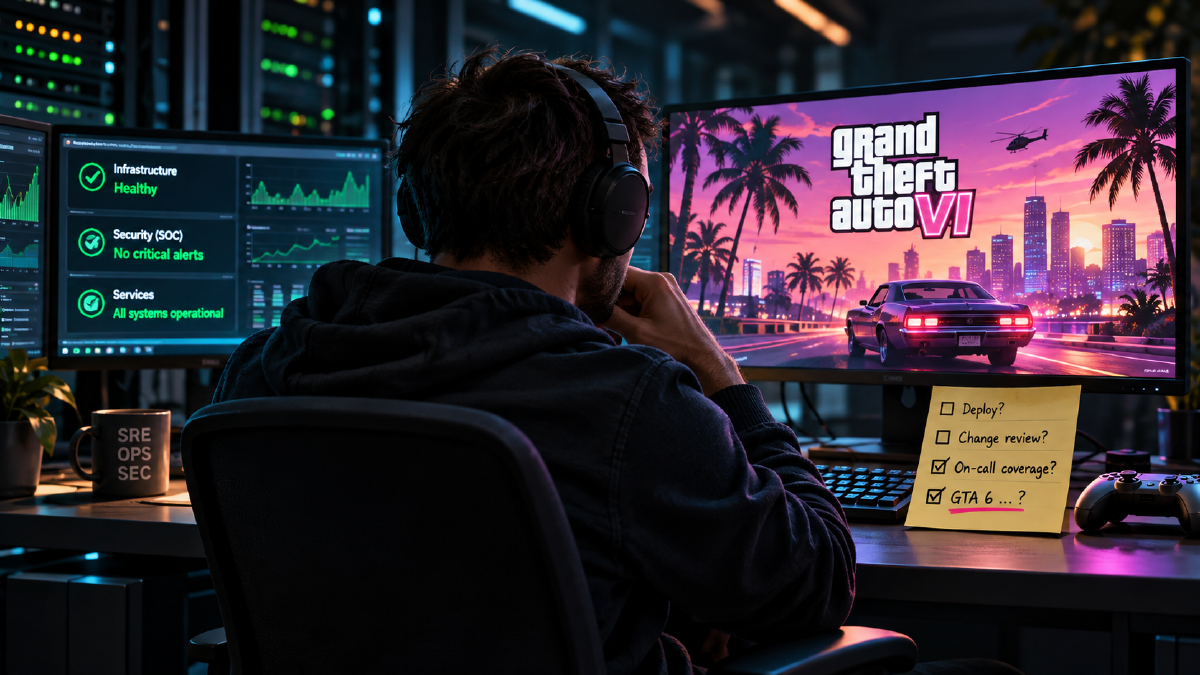
The second risk concerns me considerably more: reduced attention among employees who are technically still working. An engineer might be sitting behind a workstation while mentally counting down the hours until they can return to the game. A developer might rush through a code review, a SOC analyst might dismiss an alert a little too quickly or a system administrator might skip that final verification because everything appears to be working. Nothing necessarily breaks immediately. The ticket gets closed, the deployment succeeds and the dashboard stays green, but the quality of the underlying decision may have suffered.
Unlike planned absence, reduced attention isn’t particularly visible in a staffing schedule. Someone can be logged in, responding to messages and attending meetings while operating with considerably less concentration than usual. This is not exclusive to gaming, of course. Personal circumstances, stress, fatigue and countless other distractions can produce similar effects. What makes an event like GTA 6 interesting is the possibility that a shared distraction could affect multiple employees within the same organization at approximately the same time.
Then there’s fatigue. Anyone who has spent an entire night gaming knows how easily a few more minutes can turn into several hours. Imagine someone finishing a gaming session at four in the morning and starting an infrastructure change at eight. Sleep deprivation affects concentration, judgement and reaction time, regardless of whether the cause is gaming, shift work or something else entirely. When the person making decisions has privileged access to production infrastructure, the consequences of a mistake can extend far beyond their own workstation.
There’s also a fourth risk that deserves attention, and it might actually become relevant before the game is even released. I’m talking about the temptation to finish everything quickly before taking time off. One last deployment before the holiday, one final firewall change or a rushed maintenance window because nobody wants unfinished work waiting when they return. We’ve all seen situations where a change that deserved proper review was pushed through because someone wanted to clear their backlog. Documentation becomes something to finish later, warnings receive less attention and shortcuts suddenly become attractive.
None of this necessarily happens because people don’t care about their work. People simply have priorities outside their jobs, and sometimes those priorities influence their decisions. GTA 6 could become another reason to rush things, just as an approaching holiday, football match or long weekend sometimes does. The difference is the possibility of many people experiencing that pressure simultaneously.
But Christmas Doesn’t Bring Down the Internet Either#
One response to the original LinkedIn discussion made a fair comparison with Christmas. During the holiday season, enormous parts of the workforce are absent, offices are practically empty and society somehow continues functioning. If organizations can survive Christmas and New Year with significantly reduced staffing, why should a video game release suddenly become a cybersecurity concern?
It’s a reasonable argument, but I think it overlooks an important distinction. Christmas is predictable, and organizations generally know they need to prepare for reduced staffing. Holiday schedules, on-call arrangements, change freezes and adjusted operational procedures are common ways of maintaining continuity during those periods. A major gaming release is also predictable, but organizations may not consider it relevant to operational planning, particularly if they underestimate how much interest exists among their own technical employees.
More importantly, there’s a difference between reduced availability and reduced attention. When an engineer is officially on vacation, everyone knows that person isn’t available. Responsibilities can be transferred, coverage can be arranged and expectations can be adjusted accordingly. When an engineer is technically available but exhausted, distracted or rushing through their work, the organization may have no indication that anything has changed. A green presence indicator in Microsoft Teams doesn’t tell you much about someone’s ability to make a good technical decision.
That doesn’t mean employers should start monitoring their employees’ gaming habits, sleep schedules or personal interests. Such an approach would be an absurd response to a legitimate operational question. The objective should be to understand human limitations and design resilient processes around them, not to introduce another layer of employee surveillance.
Attackers Don’t Need Everyone to Be Distracted#
Cybersecurity is partly about timing. Attackers don’t necessarily need a new zero-day vulnerability when existing weaknesses remain unaddressed. They need an opportunity, sufficient access and enough time to achieve their objective. A delayed response to an alert can matter, as can an overlooked authentication anomaly, an improperly reviewed change or a compromised account that remains unnoticed longer than it should.
Would attackers deliberately coordinate their activities around the GTA 6 release? It’s possible, but we have no evidence that they will, and a plausible scenario shouldn’t automatically be presented as an emerging threat. Nevertheless, attackers have exploited periods of reduced availability and slower response in the past. Weekends, holidays and other periods with limited staffing can provide opportunities when defensive capabilities are weaker than usual.
What interests me more is whether organizations would even notice a temporary reduction in operational alertness. We measure detection times, response times, incident volumes and infrastructure availability. We collect enormous amounts of telemetry from networks, endpoints, applications and security platforms. Yet those measurements don’t necessarily tell us much about the quality of human decisions being made behind the dashboards.
A monitoring platform can tell us that an alert was acknowledged within thirty seconds. It cannot automatically determine whether the analyst understood its significance or dismissed it because they were tired, distracted or simply trying to finish their shift. A change management system can record that a deployment was approved, but that approval doesn’t guarantee the reviewer gave it the attention it deserved. We have become exceptionally good at measuring technical activity while still struggling to understand the human factors that influence its quality.
Technology Cannot Completely Eliminate Human Error#
I’ve spent enough years working with Linux, infrastructure, automation and security to know that technology can eliminate an enormous amount of unnecessary manual work. Proper monitoring helps identify anomalies, automated deployments reduce inconsistent changes and Infrastructure as Code makes configurations reproducible. Peer reviews and controlled change procedures can catch mistakes before they reach production, while high availability reduces dependence on individual components. Well-designed incident-response processes can also reduce dependence on individual people.
But none of those technologies completely removes the human factor. Someone still interprets an alert, decides whether an incident requires escalation, approves a risky change or determines whether a system is healthy enough to return to production. Even highly automated environments depend on human judgement when unexpected situations occur, particularly when automated safeguards cannot confidently determine the correct course of action.
This isn’t an argument against gaming. It’s an argument against designing operational processes around the assumption that humans will always perform at their best. Engineers get tired, security analysts become distracted and experienced administrators occasionally make mistakes. If your entire security operation depends on one exhausted engineer making the correct decision at three in the morning, the problem started long before GTA 6 was announced.
In my opinion, resilience means acknowledging those limitations rather than pretending they don’t exist. We design redundant infrastructure because hardware can fail. We implement backups because data can be lost. We automate deployments because manual processes introduce inconsistencies. It makes little sense to apply those principles everywhere except to the people responsible for operating the environment.
Operational Resilience Is More Than High Availability#
When discussing high availability, we usually focus on redundant servers, load balancers, replicated databases, multiple network paths and automated failover. Those are important technical components, but operational resilience extends beyond infrastructure architecture. A perfectly redundant environment can still experience a major incident because someone made an incorrect decision, overlooked an alert or executed a poorly reviewed change.
Organizations should therefore consider human availability and decision quality as part of their operational risk management. Critical functions need adequate coverage, important alerts require clear escalation paths and unnecessary changes should be avoided during periods of reduced capacity. Automation should remove repetitive work where possible, and critical decisions shouldn’t depend entirely on a single individual.
If a team expects unusually high demand for leave around a major event, discussing staffing early is ordinary capacity planning rather than cybersecurity theatre. The same applies to ensuring that people taking time off can actually disconnect without worrying about being called back for every minor issue. A healthy operational environment shouldn’t depend on engineers being permanently available, regardless of whether they’re spending their vacation abroad or exploring a fictional city.
Perhaps most importantly, organizations should avoid creating working environments where engineers feel compelled to rush through changes before taking a few well-deserved days off. Proper planning, realistic workloads and clear handover procedures can prevent unnecessary pressure from turning into avoidable technical risks. These are not revolutionary security controls, but they address weaknesses that sophisticated technology alone cannot solve.
The Real Question Isn’t About GTA 6#
I don’t expect Grand Theft Auto VI to bring down the internet, and I certainly don’t expect every SOC analyst to abandon their dashboard or every infrastructure engineer to disappear into Vice City. I also don’t believe that enjoying video games makes someone less professional. Gaming can provide relaxation, social interaction and an opportunity to disconnect from the pressures of everyday life, something that many people working in demanding technical environments genuinely need.
But the discussion triggered by Sebastiaan’s LinkedIn post exposes an uncomfortable assumption within IT operations. We spend enormous amounts of money making infrastructure resilient against hardware failures, network outages, software defects and malicious activity. At the same time, we often assume that the people operating those systems will remain consistently available, focused and capable of making good decisions, regardless of what happens outside their professional lives.
World of Warcraft demonstrated how deeply a virtual world could influence some people’s real lives. GTA 6 might remind us that gaming is no longer a niche activity associated primarily with teenagers. The people eagerly waiting for this game may also be the people maintaining our servers, securing our networks and responding to production incidents. There’s nothing inherently wrong with that, and there shouldn’t be.
The real problem begins when our operational resilience depends on pretending those people are immune to distraction, fatigue or excitement. If a major gaming release can genuinely compromise an organization’s ability to maintain secure and reliable services, the appropriate response isn’t to blame the people playing the game. It’s to examine why the organization was so dependent on their uninterrupted attention in the first place.
GTA 6 probably won’t hack your infrastructure. But if a few distracted engineers are enough to compromise its security, perhaps the game isn’t the vulnerability worth worrying about.
Ronny Roethof